

Most people learned about past and present tense in kindergarten or earlier, so you may be wondering… “Why should I read this? I already know it.” That may be the case, but kindergarten was a long time ago, and people use tenses incorrectly without even realizing it all the time. The truth is, you may not be as grammatically correct as you think. Some of those key rules you learned near the beginning of your language experience may have slipped to the wayside as you’ve gotten older, interacted with different people, and molded to the whims of society. So, stick with me. You’ll be glad you did.
There are actually multiple types of past and present tenses. For now, let’s focus on simple past tense and simple present tense.
As you might imagine, you use the simple present tense when you’re referring to right now. You can also use this tense to describe actions that are absolute or recurrent, like “I volunteer every Sunday.” These kinds of activities are typically recognizable by the use of time expressions, such as “sometimes,” “often,” “every day,” and “never.” So, in the previous example, the word “every” should have signaled to you that this is a habitual activity. Similarly, you can use the present tense to describe scheduled events, as in “The office closes at 4 p.m. today”
The present tense uses the base word of a verb. Some examples are “play,” “write,” “edit,” and “communicate.” But, depending on whether the subject is first person, second person, or third person, and whether it’s singular or plural, the present tense may be presented differently. Here’s how it breaks down:
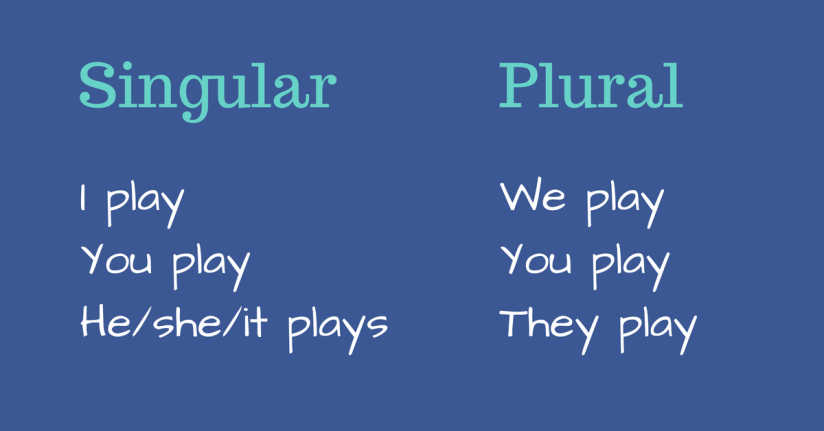
Easy, right? Those are the basics of the simple present tense. Now, let’s take a look at the simple past tense.
You use past tense when you’re referring to a previous state of being or something that has existed or transpired before now. With this tense, you refer to something that has already happened—a state that has already been completed.
To change a word from present tense to past tense, you typically just add an “-ed” to the end. For instance, you could change “I play the piano” to “I played the piano.”
This trick is useful for regular verbs, such as “play,” “explain,” or “present,” but it doesn’t usually apply to irregular verbs. As an example, some words, such as “put,” “set,” or “hit,” are the same in the present tense and in the past tense. So, you wouldn’t add the “-ed”—or make any changes at all. Then, some words seem to defy all rules completely. For instance, you would change “I write at night” to “I wrote at night.” Here, the change occurs in the middle of the word! Some other perplexing examples include “see” to “saw,” “run” to “ran,” “wake” to “woke,” and “say” to “said.” As you may have noticed, those wild irregular verbs are sprinkled everywhere throughout the English language.
Unfortunately, these tricky verb forms just have to be memorized. There’s no universal rule like there is for regular verbs. Don’t worry though—the more you use these verb forms, the easier it will be.
When it comes to the simple past tense, the subject of a sentence doesn’t necessarily change how the verb is presented. Of course, there are plenty of exceptions (most of them involving those wily irregular verbs), but a lot of the time, the past tense verb is the same across the board. Here’s an example:

Now, something that often trips people up when it comes to the past and present tenses is the usage of the infinitive verb “to be.” Here’s another table to help you visualize the appropriate verb forms:
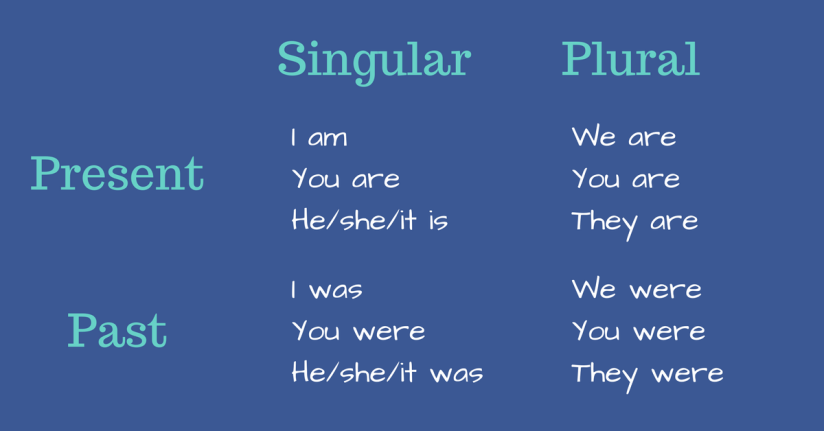
See how “to be” is a little bit erratic, with multiple verb forms across the board? Sadly, that’s not the most confusing part. You see, when talking about a hypothetical situation, you should use “were”—even if you’d normally use “was.” For instance, you wouldn’t say “If I was you, I’d try again.” Instead, you’d say “If I were you, I’d try again.” Similarly, you’d say “If it were sunny out, I’d go to the beach” or “If I were feeling up to it, I’d join you.” This is tricky because, in the past tense, the first person “I” and the third person “it” are typically paired with the past tense “was.” But, since this is a hypothetical case, “were” is correct.
So, did you learn something new? Present and past tenses are elementary, but it’s always good to brush up on the basics. Keep these fundamental tips in mind as you go about your conversations this week!

 writewell-editing.com