
10 Résumé Tips to Help You Nab Your Dream Job

In this day and age, it’s easier than ever to find and apply for job opportunities. This convenience has many benefits, but it also has one major drawback—it substantially increases the competition for nearly every job opening. That means recruiters have a massive stack of résumés to sift through and neither the time nor the inclination to thoroughly read each one. As a result, it’s more important than ever to ensure your résumé makes an immediate impression.

So, what can you do to make your résumé stand out? Here are some of the techniques WriteWell uses to ensure its clients’ résumés pop.

  1. Think of your résumé as your brand story.

When you’re applying for a job, you’re essentially selling you. To do that effectively, you need to have a strong personal brand that showcases your knowledge, experience, and abilities. What do you want the recruiter to think of you after reviewing your résumé?

Once you’ve established your desired brand image, weave it into every aspect of your résumé. The person reading it should feel as if they’re reading a story of your progress as a professional. And, it should be absolutely clear what they’re supposed to take away from your résumé.

To do this, before getting started, jot down three to five brand points that you want to highlight throughout the document. Then, with every decision you make about your résumé, go back to these brand points and ensure they’re being adequately represented.

  1. Pick a tasteful but memorable design.

Most people’s résumés are black and white, painfully plain, and incredibly boring. Your résumé can stick out from the very start if you leverage a design that captures attention and breaks up the monotony.

This step isn’t an absolute necessity, especially for those in a non-creative field, but it can make a difference if done effectively. Just choose a design that makes sense according to your industry, the position you’re applying for, and the culture of the company. And, be careful not to go overboard. You don’t want your design to detract from the content of your résumé.

  1. Incorporate effective formatting.

You want your résumé to look clean and organized. Make headings clear and specific so the hiring manager can effortlessly navigate the document. Allow a reasonable amount of white space so your résumé isn’t totally cluttered and overwhelming. Maintain a pleasing balance of paragraphs and bullet points, and use fonts that are modern and easy to read. Basically, make formatting choices that leave your résumé looking sharp and professional.

  1. Include a summary statement or profile section.

When a recruiter is presented with a pile of résumés, it’s often hard for them to think of each applicant as someone other than just another job candidate. However, giving a glimpse of who you are as a person can humanize you and make you more relatable. So, consider adding a short section that mentions the position you’re applying for and highlights how you can add value in that role. You may also share a couple of your passions or interests to forge a connection between you and the person reading your résumé.

Keep in mind: Having a section like this in your résumé can be very effective, but only if it’s concise—three sentences tops. In fact, the summary statement or profile section should be cut altogether if it edges out other more important information.

  1. Put the information that provides the highest value at the top.

No one ever said your résumé had to describe education, then work experience, then skills. Be strategic about how you organize the various sections. If you think your work experience is what sets you apart as the most impressive candidate, put that information first. If the certifications you’ve received are more relevant to the position than your school education, bump the certifications section closer to the top.

Similarly, many people only put key tasks required for their job when filling out the work experience section of their résumé. That’s useful information, but it’s not nearly as compelling as the fact that executive leadership chose your business strategy out of the 300 that were submitted. So, put your most impressive and/or relevant accomplishments first to wow the hiring manager right from the start.

  1. Highlight your hard skills and your soft skills.

It’s common to see hard skills, such as proficiency with software programs, in résumés. That’s good to include if it’s relevant to the position you’re applying for, but you shouldn’t underestimate the impact of soft skills. Organizations often consider whether someone would be a cultural fit when hiring new employees, so your collaboration, communication, leadership, and decision-making skills can certainly give you an edge.

  1. Be specific about your achievements.

What do you think sounds better? “I helped reduce turnover at my organization”? Or, “I saved the organization $250,000 by developing an initiative that reduced turnover by 60 percent”?

Quantifying your accomplishments paints a vivid picture of the value you add and even bolsters your credibility. It’s easy to dismiss a vague statement as exaggeration to pump up your résumé. Specific numbers make your success tangible.

  1. Be selective about what you include on your résumé.

Did you know that hiring managers prefer for résumés to be limited to one page? That means you likely can’t fit every single job you’ve held since you were in high school. Instead of trying to cram everything into your résumé, critically evaluate your skills and experience and select only what’s relevant to the job you’re applying for. Remember, every point in your résumé should support your brand story!

  1. Tailor your résumé to each job you apply for.

It may be easier to just create one résumé and use it for every position you apply for, but it’s definitely not the most effective strategy. In fact, research shows that about 63 percent of recruiters want résumés to be customized—and they can tell if it’s not.

Another point to keep in mind is that many organizations use applicant tracking systems to narrow the candidates down. So, if your résumé doesn’t include keywords from the job description, it might get weeded out before anyone even reads it. And, even if someone does read your résumé, they won’t be very impressed if it’s only vaguely relevant to the position you’re applying for. So, take the extra time to personalize your résumé for each job opportunity.

  1. Carefully edit your résumé.

Entrepreneur.com indicates that 61 percent of recruiters will automatically dismiss a résumé that’s littered with typos and grammatical errors. Don’t let all your hard work go to the wayside for something so easy to fix! Thoroughly review your entire résumé at least a few times before you declare it complete. You may even want someone else to look it over for you to ensure you haven’t missed anything.

Finding a new job is intimidating, and it’s certainly a lot of work. But, with these résumé tips, you should be able to stand out from the crowd and, hopefully, score the position you’ve always wanted.

 

Grammar Police: Doing Away with Dangling Modifiers

Have you ever read an article or email and thought… What?! I’m totally lost.Obviously, there could be many reasons for the lack of clarity, but one common mistake that leads to such utter confusion is the “dangling modifier.”

What’s a dangling modifier, you say? Well, first, let’s define a modifier. This is a word, phrase, or clause that describes or clarifies another word or phrase. Now, modifiers are actually very useful literary tools. They allow writers to add detail, vary their sentence structure, and play with language. But, when done incorrectly, they can become the dreaded dangling modifier. This happens when the word or phrase the modifier is describing isn’t clearly stated in the sentence. In other words, when you read the dangling modifier, it’s totally unclear what it’s referring to.

Here’s an example: “As a supervisor, the team’s goals have to be set by me.” Do you see the problem here? Modifiers are usually placed right next to the word or phrase they’re modifying. Since “the team’s goals” came right after the modifier, it seemed the sentence was suggesting the team’s goals are the supervisor. And, of course, that doesn’t make any sense! So, to rectify this error, you would say: “As a supervisor, I am responsible for setting my team’s goals.” Can you tell the difference?

Let’s look at another one: “Having completed the assignment, the next task was started.” What’s the issue this time? As you may have noticed, there’s not actually a “doer” in this sentence. Who completed the assignment? Who was starting the next task? A better way of phrasing the sentence would be, “Having completed the assignment, the contractor started his next task.” That way, the doer of the action is the subject of the main clause, and it’s clear that the modifier is describing the contractor.

How about this one? “Without knowing what the CEO looked like, it was impossible to pick him out from the crowd.” This is a bit trickier, but it’s incorrect because, again, it doesn’t indicate who is performing the action. To fix this, you can change the sentence to, “Since she didn’t know what the CEO looked like, it was impossible for her to pick him out from the crowd.” In this instance, the dangling modifier itself was altered to clarify the doer and become a complete introductory clause.

Okay, let’s look at one more: “To confirm the accuracy of the data, the research was reviewed.” This may not necessarily sound wrong, but the doer of the action is unclear yet again. Who’s confirming the accuracy of the data? To correct this, you can combine the phrase and main clause, like this: “The manager reviewed the research to confirm the accuracy of the data.” Now, you can see that the manager is the one performing the action.

As you can tell, dangling modifiers can be really obvious—or they can sneak right by you if you’re not careful. So, whenever you’re using them, remember to clarify the doer of the action and ensure the reader of your text can logically deduce what the modifier is describing. That should help you keep your writing clear, descriptive, and engaging—and keep your modifiers from dangling!

Grammar Police: To Hyphenate or Not to Hyphenate?

Hyphens are one of those keyboard symbols that are so poorly understood that they’re either wildly overused or avoided altogether. They certainly have their place in writing, but they shouldn’t be thrown into text willy nilly, whenever it “feels right.” To help you understand hyphens a little bit better, here’s a list of guidelines to keep in mind when considering whether to hyphenate.

DO:

Hyphenate when two or more words are coming together to act as a single adjective before a noun. For example, you would write “well-known leader” or “high-quality performance.”

 Add a hyphen for compound numbers that are spelled out, like twenty-four or ninety-six.

Include a hyphen when it’s necessary to avoid awkwardness or confusion. For instance, “re-sign” needs a hyphen, or else it will be confused with “resign.” Or, you might say “re-elect” instead of “reelect” so the two e’s aren’t smashed together.

Use a hyphen to separate certain prefixes or suffixes from the root word. This really just depends on the situation. To give you an example, you should typically hyphenate with prefixes like “self” and “all” or suffixes like “elect.” So, you would write “self-esteem,” “all-knowing,” and “president-elect.” In addition, you should hyphenate between a prefix and a capitalized word, such as with “pro-American,” and between numbers and letters, such as with “mid-1800s.”

Hyphenate certain compound words. Unfortunately, this is subjective as well. Some compound words are written separately, some are pushed into a single word, and some are broken up by hyphens. So you just have to memorize which compound words are treated which way. To give you a few examples, some hyphenated compound words include: “merry-go-round,” “editor-in-chief,” and “son-in-law.”

Insert a hyphen to break up a word that starts on one line and ends on the next. This is probably the most familiar hyphen guideline, but there are frequently forgotten rules associated with this:

  • Make the break between syllables and at the hyphen of hyphenated words.
  • The first line should have at least two letters and the hyphen, and the second line should have at least three letters.
  • Never break up a one-syllable word like “write” or “send.”
  • Don’t divide proper nouns or proper adjectives, such as Missouri or Canadian.

DON’T:

Don’t hyphenate -ly adverbs. As was mentioned earlier, compound modifiers that come before a noun should be hyphenated. However, if the first word is an adverb ending in -ly, it’s actually incorrect to use a hyphen. This is because the “ly” inherently signals that it’s modifying a word, meaning it would be redundant to also include a hyphen. So, instead of saying “clearly-proven” or “financially-viable,” you would say “clearly proven” or “financially viable,” even before the noun the phrase is modifying.

Don’t insert a hyphen in compound modifiers that come after a noun. To use the examples from earlier, you would say “He’s a well-known leader” and “He’s a leader who is well known.” Or, “That was a high-quality performance” and “That performance was high quality.” See the difference? All you have to do is figure out which side of the noun it’s on.

Don’t include hyphens with compound parts consisting of proper nouns or proper adjectives. For instance, even when used as compound modifiers before a noun, you would say “New Age” rather than “New-Age” and “African American” rather than “African-American.”

So, how do you feel about hyphens now? This was a quick overview, so there are other examples and exceptions out there, but this general information should help you feel more confident in your understanding of hyphens and when to use them. Are you confident enough to answer the question, “To hyphenate or not to hyphenate?”

Please feel free to leave a comment to share what you learned or ask lingering questions.

Grammar Police: Simple Present Tense and Simple Past Tense

Most people learned about past and present tense in kindergarten or earlier, so you may be wondering… “Why should I read this? I already know it.” That may be the case, but kindergarten was a long time ago, and people use tenses incorrectly without even realizing it all the time. The truth is, you may not be as grammatically correct as you think. Some of those key rules you learned near the beginning of your language experience may have slipped to the wayside as you’ve gotten older, interacted with different people, and molded to the whims of society. So, stick with me. You’ll be glad you did.

There are actually multiple types of past and present tenses. For now, let’s focus on simple past tense and simple present tense.

As you might imagine, you use the simple present tense when you’re referring to right now. You can also use this tense to describe actions that are absolute or recurrent, like “I volunteer every Sunday.” These kinds of activities are typically recognizable by the use of time expressions, such as “sometimes,” “often,” “every day,” and “never.” So, in the previous example, the word “every” should have signaled to you that this is a habitual activity. Similarly, you can use the present tense to describe scheduled events, as in “The office closes at 4 p.m. today”

The present tense uses the base word of a verb. Some examples are “play,” “write,” “edit,” and “communicate.” But, depending on whether the subject is first person, second person, or third person, and whether it’s singular or plural, the present tense may be presented differently. Here’s how it breaks down:

Simple Present and Past Tenses (1)

Easy, right? Those are the basics of the simple present tense. Now, let’s take a look at the simple past tense.

You use past tense when you’re referring to a previous state of being or something that has existed or transpired before now. With this tense, you refer to something that has already happened—a state that has already been completed.

To change a word from present tense to past tense, you typically just add an “-ed” to the end. For instance, you could change “I play the piano” to “I played the piano.”

This trick is useful for regular verbs, such as “play,” “explain,” or “present,” but it doesn’t usually apply to irregular verbs. As an example, some words, such as “put,” “set,” or “hit,” are the same in the present tense and in the past tense. So, you wouldn’t add the “-ed”—or make any changes at all. Then, some words seem to defy all rules completely. For instance, you would change “I write at night” to “I wrote at night.” Here, the change occurs in the middle of the word! Some other perplexing examples include “see” to “saw,” “run” to “ran,” “wake” to “woke,” and “say” to “said.” As you may have noticed, those wild irregular verbs are sprinkled everywhere throughout the English language.

Unfortunately, these tricky verb forms just have to be memorized. There’s no universal rule like there is for regular verbs. Don’t worry though—the more you use these verb forms, the easier it will be.

When it comes to the simple past tense, the subject of a sentence doesn’t necessarily change how the verb is presented. Of course, there are plenty of exceptions (most of them involving those wily irregular verbs), but a lot of the time, the past tense verb is the same across the board. Here’s an example:

Simple Present and Past Tenses (2)

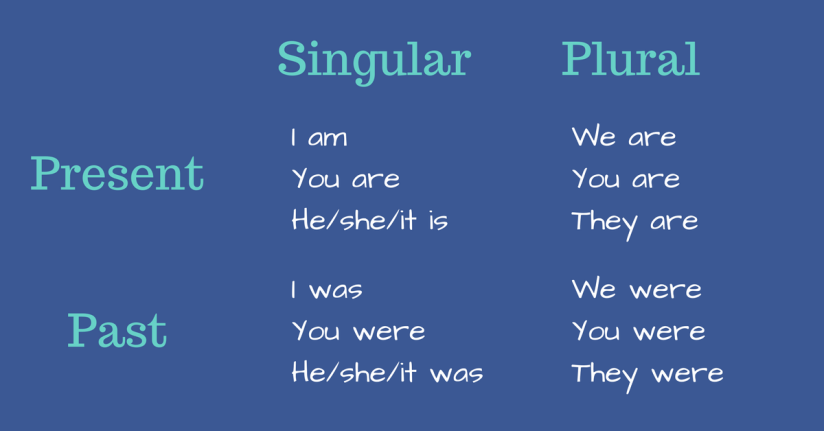
Now, something that often trips people up when it comes to the past and present tenses is the usage of the infinitive verb “to be.” Here’s another table to help you visualize the appropriate verb forms:

Simple Present and Past Tenses (3)

See how “to be” is a little bit erratic, with multiple verb forms across the board? Sadly, that’s not the most confusing part. You see, when talking about a hypothetical situation, you should use “were”—even if you’d normally use “was.” For instance, you wouldn’t say “If I was you, I’d try again.” Instead, you’d say “If I were you, I’d try again.” Similarly, you’d say “If it were sunny out, I’d go to the beach” or “If I were feeling up to it, I’d join you.” This is tricky because, in the past tense, the first person “I” and the third person “it” are typically paired with the past tense “was.” But, since this is a hypothetical case, “were” is correct.

So, did you learn something new? Present and past tenses are elementary, but it’s always good to brush up on the basics. Keep these fundamental tips in mind as you go about your conversations this week!

Wicked Word Mix-Ups: Effect vs. Affect

There are some word pairs that are so confusing that almost everyone gets them wrong. One of those word pairs is effect and affect. In fact, these are some of the most commonly searched words on merriam-webster.com because so many people are befuddled by their similar pronunciations, spellings, and definitions.

You’re probably thinking, “True… I have no idea when to use one or the other.” Or, maybe you roll your eyes and gnash your teeth when you see someone using “effect” and “affect” incorrectly. Regardless, most everyone can connect to this topic in some way or another.

To start, “effect” has various meanings, but its most common definition is “something that inevitably follows a [cause]” (Merriam-Webster). Some synonyms are “impact,” “reaction,” “outcome,” and “consequence.” As you may have noticed, each of these synonyms are nouns–and so is “effect” when it’s used in this manner.

On the other hand, according to Merriam-Webster, “affect” means “to produce an effect upon.” …Seems pretty similar to “effect,” right? It even has “effect” in the definition! The crucial difference here is that “affect” is a verb, which involves action. Synonyms include “influence,” “transform,” and “change,” which are also verbs.

Here are some example sentences to get you thinking critically about what you just learned:

  • “The salary increases had a positive effect on employee engagement.” In this case, “effect” is the appropriate word. One way to check is to replace “effect” with one of its synonyms. For instance, the sentence would still make sense if it said: “The salary increase had a positive impact on employee engagement.”
  • “My teacher’s grading style affects the way I write my papers.” Here, “affect” is correct. For the sentence to be meaningful, a verb is required. And, words like “influences” or “changes” could replace “affects,” whereas words like “reaction” or “consequence” would completely mangle the sentence.
  • “My personality effects the team dynamic.” …That doesn’t look right, does it? You need a verb instead of a noun.
  • “The affect was an increase in employee turnover.” That’s not right either. This time, you need a noun, not a verb.

As if things aren’t confusing enough already, “affect” has a couple of other definitions. First, as a noun, it can be used in the context of psychology to refer to feeling or emotion. It’s almost never used as a noun in any other setting. In many ways, this word has become obsolete.

Second, “affect” can mean “to cause strong emotions in” or “to put on a pretense of” (Merriam-Webster.) With this definition, “affect” is being used as a verb, but it has more of an emotional connotation. For instance, you could say, “She affected an indifferent demeanor, but I knew she was deeply hurt by the rejection.” Or, “I was strongly affected by the speaker’s heartfelt speech.”

To make things even more complicated, “effect” can also be used as a verb meaning “to cause to come into being” or “to put into operation.” So, you might say, “We are going to effect a change.” Or, “She had little power to effect a new budget.”

If this is still making your head spin, try to replace “effect” with one of its synonyms, such as “enact,” “implement,” “cause,” or “achieve.” For instance, “We are going to implement a change” makes perfect sense. However, a synonym of the noun “effect” would transform the sentence to this: “We are going to reaction a change.” That certainly doesn’t sound right!

Wow! Is it any wonder that people get mixed up over “effect” versus “affect”? There is so much to keep straight when it comes to this tricky word pair! To make it easy on yourself, don’t worry too much about memorizing “effect” as a verb and “affect” in relation to emotion. Sometimes, using such language can make you sound a bit haughty and pretentious. So, unless you’re positive you’re using the words correctly and that tone is ideal for the setting and situation, you can feel free to avoid those usages.

Here’s what you absolutely need to remember: Most of the time, when you use the word “effect,” you’re using it as a noun meaning “impact” or “outcome.” And, when you use the word “affect,” you’re usually using it as a verb meaning “influence” or “cause.” It’s most important to master these usages because they’re super common–and you don’t want to make your peers, boss, or interviewer groan over your seemingly lacking English skills.

Still kind of fuzzy? Check out this link to see if it clears things up for you.